
How do you safely tune a Volkswagen Touareg?
Last Updated: October 25, 2026
Quick Summary
Volkswagen Touareg tuning modifies ECU software to adjust fuel injection, ignition timing, and boost pressure for increased power and throttle response. Safe tuning requires matching the correct tune file to your specific engine variant and ECU model, using compatible flashing hardware like the FlashZilla device, and maintaining stricter service intervals afterward.
- Verify your exact engine code and ECU model before ordering a tune, as mismatched hardware and software can damage the engine.
- Change engine oil and filter every 5,000 miles after tuning instead of the factory interval using high-quality synthetic oil.
- Inspect the turbocharger, intercooler, EGR system, fuel system, transmission, and cooling system before and after tuning.
- Do not delete or bypass emissions equipment like the DPF or SCR system, as it is illegal and can void warranties.
- Stop driving immediately if you see overboost code P0234 or fuel rail pressure codes and have the tune reviewed.
Table of Contents
- Understanding Volkswagen Touareg ECU Tuning Basics
- Touareg TDI Tuning: Engine-Specific Optimization
- Performance Gains and What to Expect
- Volkswagen ECU Tune Installation Tools and Setup
- Touareg Tuning Safety and Maintenance Considerations
- Generation, Engine, and Drivetrain Compatibility
- Getting Started with Your Touareg Tune
- Frequently Asked Questions
Understanding Volkswagen Touareg ECU Tuning Basics
Volkswagen Touareg tuning starts with understanding what ECU tuning does. The engine control unit manages fuel injection, ignition timing, and boost pressure.
ECU tuning is a process, not a product: read your engine's current settings, adjust parameters like fuel timing and turbo boost, and write the changes back. Done correctly, you get measurable gains; done poorly, you risk engine damage.
At H&A Midwest, every tune includes the FlashZilla device needed to flash your ECU safely, no separate purchase required. Compatibility between tune file and flashing hardware is non-negotiable, mismatched hardware and software is how engines get bricked.
Your Touareg's engine has factory-conservative settings, tuned for reliability across millions of vehicles in varied climates and conditions. Your specific car can handle more, and a proper tune unlocks that potential without crossing into danger.
Touareg TDI Tuning: Engine-Specific Optimization
TDI diesel engines respond differently than gasoline engines. Diesel burns hotter and creates more torque naturally, and the turbo already works hard from the factory. Tuning focuses on boost levels, fuel injection timing, and EGR behavior.
For the Volkswagen Touareg tuning process with TDI engines, know your exact engine variant first. The 3.0L TDI comes in 240PS, 245PS, and 262PS versions, each with different factory settings.
Volkswagen's official technical documentation outlines the differences between these engine generations. The ECU model matters too. Some Touaregs use the EDC17CP24 control unit, while others use different modules.
Common TDI tuning modifications include:
- Increasing turbo boost pressure for more power
- Adjusting fuel injection timing for better response
- Modifying EGR (exhaust gas recirculation) parameters
- Optimizing fuel rail pressure settings
The VW Touareg 3.0 TDI 240PS tune from H&A Midwest is engineered specifically for your engine variant. It includes the FlashZilla hardware required for installation. You confirm your engine code before ordering to ensure compatibility.
Performance Gains and What to Expect
Tuning a Touareg TDI delivers measurable changes: power and torque gains are the obvious benefits, but the real-world experience is more nuanced than raw numbers.
Throttle response improves noticeably because the tuned ECU adjusts fuel delivery and boost timing more aggressively. Highway passing becomes easier, and the engine feels more alive in city driving.
Fuel economy can improve or worsen depending on how you drive. A conservative driver may see slight efficiency gains; an aggressive one exploiting the extra power will burn more fuel. That's physics, not a tune failure.
The guide explains what different tuning levels deliver. Understanding the difference helps you set realistic expectations.
Tuning is not magic. You're extracting performance the engine already has, not adding horsepower from nowhere. Factory settings leave reliability margins; a proper tune reduces them slightly while staying within safe operating parameters.
Volkswagen ECU Tune Installation Tools and Setup
Installing an ECU tune requires specific hardware and preparation, where most DIY tuners make mistakes by skipping steps or using incompatible equipment.
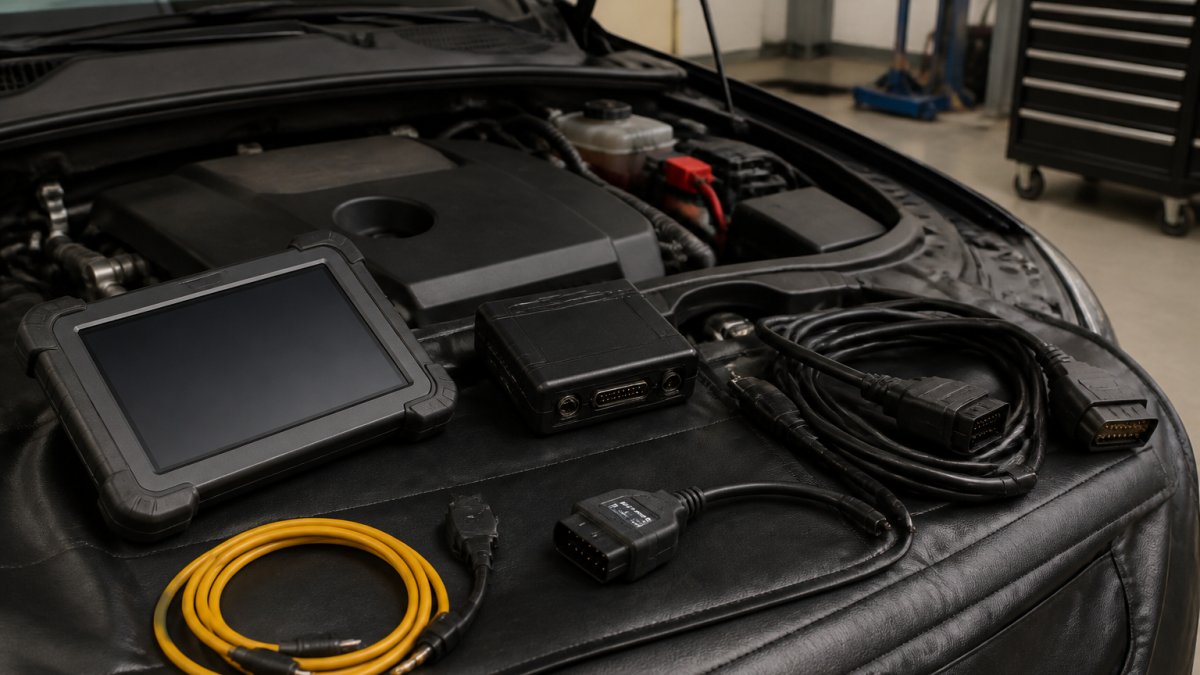
Before you start, prepare your workspace:
- Fully charge your car battery or connect a battery maintainer
- Ensure the engine is completely cold
- Park in a safe location where you can leave the car running
- Keep the ignition off until you're ready to flash
- Have your tune file downloaded and verified on a laptop
Flashing takes about thirty minutes. Connect the FlashZilla to the OBD port and your laptop via USB, launch the software, select your tune file, and verify the engine code matches.
Once the flash completes and the device confirms success, the new tune takes effect immediately, you'll notice the difference the moment you drive.
Common mistakes to avoid:
- Using an older version of the flashing software
- Connecting to the wrong OBD port (some vehicles have multiple)
- Attempting to flash with a low battery
- Interrupting the flash process mid-way
- Flashing the wrong tune file to your vehicle
The VW Touareg 3.0L CR TDI CATA EDC17CP24 tune from H&A Midwest is pre-configured for your specific ECU. Compatibility is verified before you receive it.
Touareg Tuning Safety and Maintenance Considerations
Tuning increases engine stress: more fuel burning, higher combustion temperatures, greater boost pressure. Most guides stop at "change your oil more often," but that is not enough for a Touareg. This section covers what to inspect, and how to keep a tuned Touareg reliable.
What Added Torque and Heat Actually Stress
A tune raises cylinder pressure and exhaust gas temperature. On the 3.0L TDI, the turbocharger, intercooler, EGR system, and transmission see the biggest change: the turbo spins faster and hotter, the intercooler rejects more heat, the EGR handles more soot and thermal cycling, and the eight-speed automatic manages more torque than the factory calibration assumed.
The first symptoms usually appear as drivability issues, not engine failure: boost deviation codes, EGR fault codes, or transmission shudder under load.
Component-by-Component Inspection Checklist
Inspect these items before and after tuning.
- Turbocharger: Check for shaft play, oil seepage at the compressor housing, and boost deviation codes.
- Intercooler and charge pipes: Look for oil residue, cracked end tanks, and loose clamps. Boost leaks cause overboost and underboost codes and rob power.
- EGR system: On TDI engines, a clogged EGR cooler or sticking EGR valve becomes more problematic with a tune.
- Fuel system: High-pressure fuel pump and injectors work harder.
- Transmission: The eight-speed automatic benefits from a fluid and filter service if mileage is high.
- Cooling system: Check coolant level, thermostat operation, and radiator condition.
- Emissions equipment: Diesel particulate filter (DPF) and selective catalytic reduction (SCR) systems are sensitive to tuning.
Maintenance Schedule After Tuning
- Change engine oil and filter every 5,000 miles instead of the factory interval. Use a high-quality synthetic oil that meets the manufacturer specification for your engine.
- Replace the air filter more frequently, especially if you drive in dusty conditions.
- Service the transmission fluid and filter earlier than the factory schedule, particularly on higher-mileage vehicles.
- Inspect boost hoses and clamps at every oil change.
- Check for fault codes at every service, even if the check engine light is off.
Warning Signs to Stop Driving
Some codes mean stop, not "drive to the shop later." If you see overboost code P0234, the turbo is over-pressurizing. Stop driving and have the tune reviewed. Other codes to treat seriously include fuel rail pressure codes, transmission over-temperature warnings, and any code accompanied by smoke or power loss.
Warranty and Legal Reality
Volkswagen may refuse warranty work on a tuned vehicle if the tune is linked to the failure. Check your warranty terms before flashing and keep the original tune file to restore factory settings.
Emissions compliance matters too. In regions with annual inspections, a tune that increases emissions or disables monitors can fail.
The Reliability Rule
A tuned engine with proper maintenance will outlast a neglected stock engine. A tuned engine with poor maintenance will fail faster than a stock engine. The difference is inspection and early intervention. Treat the checklist above as part of the tune, not an optional add-on.
Generation, Engine, and Drivetrain Compatibility
Not all Touareg tuning solutions work on all Touaregs, generation, engine type, and drivetrain all matter. Use the compatibility matrix below as a starting point, then verify against your own vehicle's documentation.
Touareg Generations at a Glance
The first generation (7L, roughly 2002-2010) used older ECU architectures and engine families. The second (7P, roughly 2010-2018) introduced the 3.0L TDI variants. The third (CR, 2018+) uses newer ECU and emissions hardware. A tune built for one generation will not work on another.
Engine Code and ECU Compatibility Matrix
Use this as a reference, not a substitute for verifying your own engine code. Engine codes appear on the vehicle's data sticker and can be read with a scan tool.
| Generation | Engine | Common Engine Codes | Displacement | Typical ECU Family | Notes |
|---|---|---|---|---|---|
| 7L | 3.0L V6 TDI | BKS, BUN, CASA | 3.0L | EDC16/EDC17 variants | Older architecture |
| 7P | 3.0L V6 TDI 240PS | CATA, CJMA | 3.0L | EDC17CP24 | Verify ECU before ordering |
| 7P | 3.0L V6 TDI 245PS | CRCA, CJMA | 3.0L | EDC17CP24/CP44 | Confirm exact ECU variant |
| 7P | 3.0L V6 TDI 262PS | CVVA, CRCA | 3.0L | EDC17CP44 | |
| 7P | 3.6L V6 FSI | CGRA, CMTA | 3.6L | Bosch MED17 | Gasoline |
| 7P | 4.2L V8 TDI | CKDA | 4.2L | EDC17CP44 | |
| CR | 3.0L V6 TDI | DDVB, DDVC | 3.0L | Newer EDC17/EDC19 | Emissions hardware differs |
Drivetrain and Transmission Considerations
Drivetrain affects how extra power reaches the road. Most Touaregs use 4Motion all-wheel drive. Transmission type matters more: the eight-speed automatic (common in 7P and CR generations) has different torque limits and adaptation behavior than older six-speed automatics, and with a manual, clutch capacity becomes the limiting factor before the engine does.
- 4Motion: Generally robust, but service the transfer case and differentials on schedule.
- Eight-speed automatic: Watch for shudder under load after tuning; consider a transmission adaptation reset.
- Six-speed automatic: Older units may have lower torque headroom; verify with your tuner.
- Manual: Clutch upgrade may be needed if torque rises significantly.
How to Verify Your Exact Specification
Do not guess from model year alone. Pull your VIN and decode it. Read the engine code with a scan tool. Note the ECU model number. Record the transmission type and drivetrain. Cross-reference against your vehicle's documentation. Then confirm with your tuner that the file matches all of those details.
H&A Midwest provides tuning solutions for multiple Touareg variants. The VW Touareg 3.0 TDI 245PS and VW Touareg 3.0 TDI 262PS options cover different power outputs. Each tune is engineered for its specific engine variant. If your engine code is not listed, ask before ordering.
Getting Started with Your Touareg Tune
Start by documenting your current vehicle state: odometer reading, existing modifications like exhaust or intakes, and photos of your engine bay. This baseline helps you track changes and troubleshoot if needed.
Next, confirm your exact engine specification: pull and decode your VIN, verify the engine code on your ECU, and write down the result. Do not guess or assume based on model year alone.
Order your tune with the FlashZilla hardware included. H&A Midwest delivers complete packages. No separate hardware purchases. No compatibility guessing. Everything you need arrives together.
Before flashing, review the installation guide and any video tutorials, prepare your workspace, charge your battery, then flash with confidence.
Frequently Asked Questions
Can you tune a Volkswagen Touareg ECU safely?
Yes, ECU tuning is safe for a Volkswagen Touareg when done correctly with quality hardware and proper compatibility checks. The key is verifying your specific engine code, model year, and current tune status before flashing. Using professional-grade tools like FlashZilla hardware and validated tune files reduces the risk of errors like overboost conditions or fault codes. Always start with conservative power levels and monitor engine behavior after installation.
How much power can a Touareg TDI tuning add?
A Touareg TDI tuning can provide enhanced performance. Results vary by model year, engine generation, and whether you've already installed bolt-on upgrades.
Does a Touareg need hardware upgrades before an ECU tune?
Most Touareg models don't require hardware upgrades before a basic ECU tune, but your specific setup matters. If you've already installed a cold-air intake or downpipe, confirm compatibility with your tune file.
What should you check before tuning a used Touareg?
Before tuning a used Touareg, verify the engine code, model year, and current mileage. Confirm the ECU hasn't been previously tuned or modified. Ensure your vehicle is stock or document all existing modifications to match them with the correct tune variant.
Tuning your Volkswagen Touareg is achievable without professional installation. The right tools and preparation make the difference between success and costly mistakes. H&A Midwest delivers FlashZilla hardware with every tune, eliminating compatibility concerns. Your Touareg's TDI engine has untapped potential. A proper tune unlocks it safely.
