
Stage 1, 2, 3, 4 Tuning Explained: A 2026 Guide
Table of Contents
- What Is Stage Tuning?
- Stage 1 Tuning: Software Optimization for Beginners
- Stage 2 Tuning: Adding Hardware Modifications
- Stage 3 Tuning: Comprehensive Performance Upgrades
- Stage 4 Tuning: Advanced Engine Building
- Comparison Table: What Each Stage Delivers
- Insurance, Legal, and Maintenance Considerations
- Choosing Your Tuning Stage: A Decision Framework
- Frequently Asked Questions
Last Updated: October 2, 2026
What Is Stage Tuning?
Stage tuning is a structured approach to engine performance optimization that progresses through distinct levels of modification, each building on the previous stage. Rather than randomly adding upgrades, stage tuning provides a roadmap: start with software optimization, add hardware modifications in sequence, and build toward comprehensive engine building. Each stage represents a specific power band, supporting modifications, and reliability threshold.
Stage 1 Tuning: Software Optimization for Beginners
Stage 1 tuning is pure software calibration, no hardware changes required. A technician accesses your vehicle's ECU through the OBD port using specialized flashing hardware, then uploads a custom tune file that adjusts fuel injection timing, boost pressure, ignition advance, and air-fuel ratio parameters. The result is immediate: your engine produces more power from the same displacement.
How Stage 1 Tuning Works
Stage 1 optimization targets the engine management system's conservative factory calibration. Manufacturers tune engines to pass emissions tests, accommodate poor fuel quality across regions, and provide warranty coverage. This means factory maps leave performance on the table.
A Stage 1 ECU remap adjusts several core parameters:
- Boost pressure: Turbochargers and superchargers operate at reduced pressure from the factory. A Stage 1 tune increases wastegate duty cycle to raise boost output safely.
- Fuel injection timing: Advancing fuel injection improves combustion efficiency and throttle response.
- Ignition advance: More aggressive spark timing increases cylinder pressure and power output.
- Air-fuel ratio: Leaning the mixture slightly improves efficiency without sacrificing reliability on quality fuel.
Is Stage 1 Tuning Safe for Daily Driving?
Stage 1 tuning is generally safe for daily driving when executed correctly. The modification stays within the engine's existing mechanical limits, no new stress is imposed on internal components like pistons, rods, or valve trains. The engine still operates at factory tolerances for bearing clearance, cooling capacity, and fuel system delivery.
Stage 2 Tuning: Adding Hardware Modifications
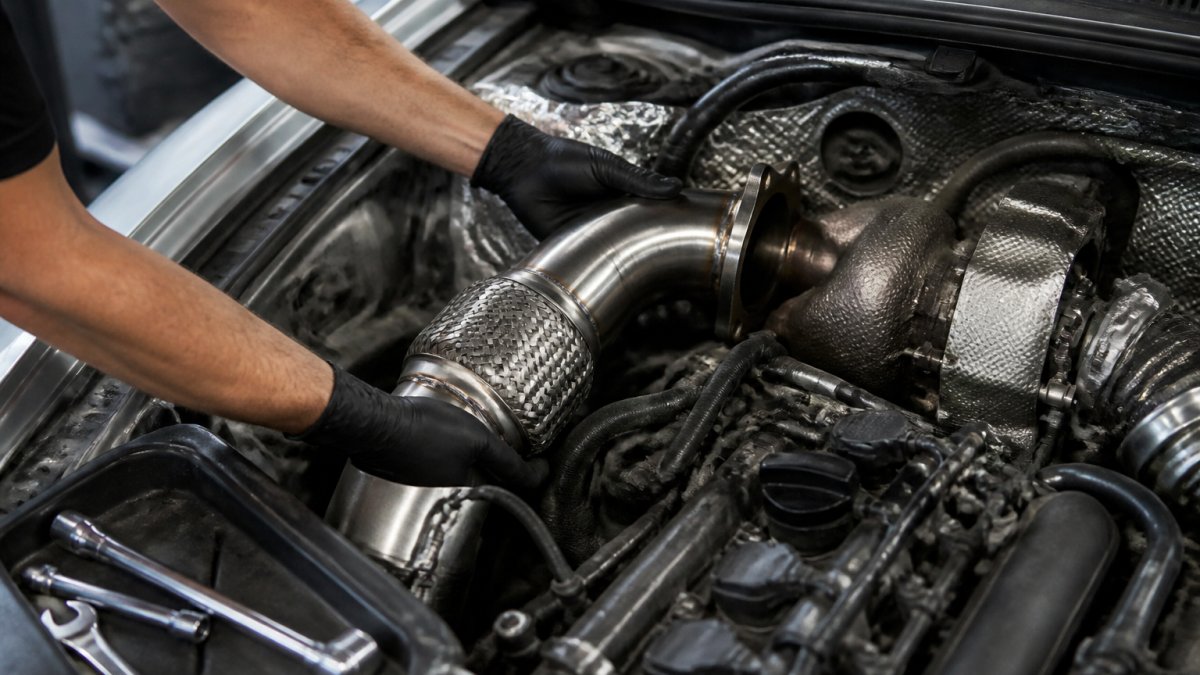
Stage 2 introduces physical bolt-on components that complement the software calibration. At Stage 1, your engine is optimized but still restricted by factory intake and exhaust systems. Stage 2 removes those bottlenecks.
Hardware Requirements for Stage 2 Tuning
Stage 2 modifications typically include:
- Catback exhaust system: Replaces the factory muffler and resonator with a less restrictive design. Reduces exhaust backpressure, allowing combustion gases to exit faster and improving scavenging efficiency.
- Downpipe: Sits between the turbocharger and catalytic converter. A high-flow downpipe reduces turbulence and exhaust gas temperatures, critical for forced induction engines.
- Air intake system: Replaces the factory airbox with a cold-air intake that draws cooler, denser air into the engine. Cooler intake air contains more oxygen molecules per volume, improving combustion.
- Intercooler upgrade: For turbocharged engines, a larger or more efficient intercooler cools compressed air before it enters the cylinders, increasing air density and reducing knock tendency.
These modifications work synergistically with a Stage 2 ECU tune. The tune adjusts fuel and ignition parameters to take advantage of improved airflow and reduced exhaust restriction. Without the hardware, the tune cannot deliver its full potential. Without the tune, the hardware provides only modest gains.
Stage 3 Tuning: Comprehensive Performance Upgrades
Stage 3 is where tuning transitions from bolt-ons to more invasive modifications. You're no longer optimizing the factory engine, you're fundamentally upgrading its capability.
Stage 3 typically includes:
- Fuel system upgrades: Larger injectors to supply more fuel at higher pressures. Factory injectors max out around 550cc; Stage 3 often requires 850cc+ injectors.
- Turbocharger or supercharger upgrade: Replacing the factory forced induction unit with a larger, more efficient turbo that spools faster and produces higher boost pressure.
- Engine internals preparation: Upgrading to forged pistons, reinforced connecting rods, and upgraded valve springs to handle the increased pressure and RPM capability.
- Cooling system overhaul: Larger radiators, upgraded water pumps, and auxiliary cooling circuits to manage the heat generated by aggressive tuning.
- Data logging and custom mapping: Moving beyond off-the-shelf tune files to dyno-tested, engine-specific calibrations that account for your exact modifications and driving conditions.
Performance Gains from Stage 3 Tuning
Stage 3 modifications typically deliver significant brake horsepower gains on turbocharged platforms, with substantial torque increases. These numbers assume quality execution and proper supporting modifications. A Stage 3 tune on a factory fuel system or with inadequate cooling will underperform and risk engine damage.
Stage 4 Tuning: Advanced Engine Building
Stage 4 is full engine building, complete internal overhaul with high-compression pistons, race-spec camshafts, ported and polished cylinder heads, and often displacement increases through boring or stroking. This is no longer tuning; it's engine reconstruction.
Comparison Table: What Each Stage Delivers
| Stage | Primary Focus | Hardware Required | Typical BHP Gain | Typical Torque Gain | Daily Drivability | Maintenance Impact | Reliability Risk |
|---|---|---|---|---|---|---|---|
| Stage 1 | ECU optimization | None (Flashzilla hardware only) | 20-40 | 30-60 | Excellent | Minimal | Low |
| Stage 2 | Bolt-on hardware + tune | Exhaust, intake, downpipe | 40-70 | 60-100 | Excellent | Low | Low-Moderate |
| Stage 3 | Forced induction upgrade + internals | Turbo, injectors, pistons, cooling | 100-150 | 120-180 | Good | Moderate | Moderate |
| Stage 4 | Full engine rebuild | Complete internal overhaul | 150-250+ | 180-300+ | Poor | High | High |
Insurance, Legal, and Maintenance Considerations
This is where most tuners encounter unexpected problems. Stage tuning exists in a gray zone legally and contractually, it's not illegal, but it carries consequences many owners don't anticipate.
Insurance and Warranty Impact
Your insurance policy likely excludes coverage for modified engines. When you file a claim after a tuning-related failure, insurers investigate. If they discover your engine has been remapped, they may deny the claim entirely. Some policies require disclosure of modifications; failure to disclose can void coverage retroactively.
Maintenance Schedule Adjustments
Stage tuning increases mechanical stress, which means maintenance intervals must tighten. Here's what changes:
- Oil changes: Factory intervals (typically 10,000 miles) should drop to 5,000-7,500 miles for Stage 2+. Stage 3+ engines benefit from 3,000-5,000 mile intervals.
- Spark plugs: Hotter combustion pressures foul plugs faster. Stage 2+ engines may need plugs every 15,000-20,000 miles instead of 30,000.
- Coolant and brake fluid: These fluids degrade faster under higher thermal stress. Annual flushes become necessary instead of every two years.
- Transmission fluid: If your car is turbocharged and tuned, transmission stress increases. More frequent fluid changes extend transmission life.
Diagnostic and Data Logging
Stage 3+ tuning requires ongoing diagnostic monitoring. A quality tune shop will provide data logging capability, real-time monitoring of boost pressure, air-fuel ratio, ignition timing, and exhaust gas temperatures. This data reveals whether your tune is stable or pushing into dangerous territory.
Common issues that data logging catches:
- Boost spikes: Turbocharger overshooting target pressure, causing detonation.
- Air-fuel ratio excursions: Mixture swinging too lean, risking engine damage.
- Exhaust gas temperatures climbing dangerously: Indicating too much timing advance or boost.
Choosing Your Tuning Stage: A Decision Framework
Selecting the right stage depends on three factors: your performance goals, your maintenance commitment, and your risk tolerance.
Frequently Asked Questions
What is the main difference between stage 1 and stage 2 tuning?
Stage 1 tuning is purely software-based, modifying your ECU calibration through an OBD port flash to optimize fuel injection, ignition timing, and boost pressure. Stage 2 adds physical hardware upgrades like a downpipe, catback exhaust, and air intake system alongside the ECU remap. Stage 1 delivers 20-40 BHP gains; Stage 2 typically adds another 20-50 BHP by reducing exhaust backpressure and improving air intake efficiency. Stage 2 requires the supporting modifications to work safely and effectively.
Is a stage 2 tune illegal for street use?
Legality depends on your location and whether your tuned vehicle meets emissions compliance standards. Many stage 2 tunes modify exhaust gas temperatures and air-fuel ratio in ways that may not pass emissions testing. Some regions allow tuned vehicles on public roads if they pass inspection; others prohibit any ECU modification. Check your local regulations and contact your insurance provider before tuning, as many policies exclude coverage for modified engines. Non-compliance can result in fines or vehicle impounding.
Do I need hardware upgrades for stage 1 tuning?
No. Stage 1 tuning requires only ECU remapping via an OBD port flashing tool, no physical hardware changes. You can run stage 1 safely on a stock engine. However, if you plan to progress to stage 2 or 3, you'll need to add bolt-on modifications like a downpipe, catback exhaust, and air intake system to safely handle the increased engine output and manage exhaust gas temperatures.
How does tuning affect my vehicle's warranty?
Most manufacturer warranties become void once you modify the ECU or engine components. Dealers can refuse warranty claims on engine-related issues if they detect tuning. Some insurance providers also exclude coverage for tuned vehicles or charge higher premiums. Before tuning, contact your insurer to understand your coverage and document your modifications. Consider purchasing aftermarket warranty coverage designed for modified vehicles if long-term protection is important to you.
What performance gains can I expect from stage 3 tuning?
Stage 3 tuning combines ECU optimization with advanced hardware upgrades such as an upgraded turbocharger, intercooler, fuel injectors, and internal engine reinforcements. Depending on your vehicle, expect significant BHP gains over stock, with substantial torque increases. Stage 3 also improves throttle response and powertrain efficiency. However, stage 3 requires meticulous maintenance, data logging to monitor engine health, and may reduce engine longevity if not managed carefully with proper cooling and fuel quality.
Does stage 4 or stage 5 tuning exist?
Stage 4 and stage 5 tuning exist in some tuning communities but lack standardized definitions. Stage 4 typically involves extreme forced induction upgrades, engine internals rebuilds, and custom ECU calibration. Stage 5 is rarely used and represents experimental or competition-level builds. Most road-legal tuning stops at stage 3 due to reliability, insurance, and legal concerns. For daily-driven German luxury cars, stage 2 or stage 3 offers the best balance of performance and practicality.
Will tuning damage my engine or affect its longevity?
Stage 1 tuning has minimal impact on engine longevity if your vehicle is well-maintained. Stage 2 and 3 tuning increase stress on the drivetrain, turbocharger, and internal components, potentially reducing engine life depending on driving habits and maintenance. Regular oil changes, fuel quality, and data logging to monitor exhaust gas temperatures and boost pressure are essential. Proper cooling upgrades and avoiding extreme driving conditions help preserve reliability. Stage 3+ builds may require internal engine reinforcement to withstand sustained performance demands.
What hardware do I need to flash a stage 1 tune myself?
You need an OBD port flashing tool compatible with your vehicle's ECU. These devices connect to your car's diagnostic port and allow you to upload the tuned file directly to your engine management system. The tool must support your specific make and model, VW, Audi, BMW, and Mercedes each have different ECU architectures. Many tuning providers bundle the flashing hardware with their tune package to ensure compatibility and reduce the risk of errors like Error_Invalid_File or bricking your ECU. Always verify hardware compatibility before purchase.
Engine tuning delivers real performance gains, but only when executed methodically. Stage tuning provides the roadmap. Start with software, add hardware strategically, and commit to maintenance discipline. H&A Midwest's vehicle-specific approach eliminates the guesswork, you get a tune engineered for your exact platform, paired with compatible flashing hardware, and supported by diagnostic guidance. The result is reliable, repeatable power gains without the trial-and-error that damages engines.