
ECU Tuning Explained: A 2026 Guide for German Cars
Table of Contents
- What ECU Tuning Actually Changes Under the Hood
- ECU Tuning Stages Explained: Stage 1, 2 and 3
- Is ECU Tuning Safe for Daily Drivers?
- Best ECU Tuning Tools for Beginners
- Diagnostic and Data Logging: Reading Your Car After the Flash
- Legal, Emissions and Warranty Realities
- Conclusion
- Frequently Asked Questions
Last Updated: September 29, 2026
What ECU Tuning Actually Changes Under the Hood
ECU tuning is the process of rewriting the calibration tables inside a vehicle's engine control unit to change how the engine behaves. This guide from H&A Midwest walks through what actually changes, what the stages mean, and what you should check before flashing your own car.
The engine control unit is the computer that decides how much fuel to inject, when to fire the spark, and how much turbo boost pressure to allow. Every one of those decisions is governed by lookup tables stored in the ECU's firmware. Flash programming replaces those tables; a tuning box intercepts sensor signals before they reach the ECU. That distinction matters more than most buyers realise.
The Engine Control Unit and the Signals It Reads
The engine control unit reads a constant stream of sensor signals: mass airflow, manifold pressure, intake air temperature, knock detection, oxygen content in the exhaust, and throttle position. It cross-references those inputs against its mapping parameters and outputs commands for ignition timing, fuel-to-air ratio, and turbo boost pressure.
Change the tables, and you change the outputs. Advance ignition timing and you can pick up torque; add fuel under boost and you can pick up horsepower. Push either too far and knock detection pulls timing back, or worse, the engine detonates.
Flash Programming vs. Tuning Boxes: How the Hardware Differs
Flash programming writes directly to the ECU through the OBDII port, replacing the factory calibration with a modified one. A tuning box sits between the ECU and the sensors, intercepting signals and feeding altered values. Flash tuning gives full control over every mapping parameter; a tuning box only manipulates the signals it can intercept.
For German cars specifically, flash programming is the more common route because the ECU firmware is well documented and the OBDII port supports it without desoldering the chip.
ECU Tuning Stages Explained: Stage 1, 2 and 3
| Stage | Hardware Required | Typical Change | Best For |
|---|---|---|---|
| Stage 1 | None (stock) | Software only | Daily drivers wanting more response |
| Stage 2 | Intake, downpipe, intercooler | Software plus bolt-ons | Enthusiasts with supporting mods |
| Stage 3 | Big turbo, fuel system, internals | Full build calibration | Track and high-power builds |
What most stage guides miss is that the jump from Stage 1 to Stage 2 is not just about bolting on parts, it is about whether your ECU has the calibration resolution to manage the new hardware. Some factory ECUs have limited mapping tables for increased airflow, and tuners must work around those limits. Before committing to a stage, ask your tuner whether your specific ECU and engine code support the calibration changes required. That single question prevents more failures than any other.
Is ECU Tuning Safe for Daily Drivers?
A Stage 1 tune on a healthy, well-maintained engine is generally safe for daily driving, provided the calibration is written for your specific vehicle and hardware. The risks appear when a generic file is flashed onto a car with different bolt-ons, or when the tune pushes boost beyond what the fuel system and intercooler can support.
Hardware Prerequisites Before You Flash
Before flashing any tune, confirm four things:
- The ECU is compatible with the flashing hardware you have
- The battery is on a charger, because a failed flash mid-write can brick the ECU
- Any bolt-ons (intake, downpipe, intercooler) match what the tune was written for
- You have a way to read and clear fault codes after the flash
Diagnostic and Data Logging: The Safety Step Most Guides Skip
Data logging is how you confirm the tune is doing what it should. After the flash, pull live data from the ECU and check boost pressure against target, fuel trims, ignition timing, and knock detection counts. If boost creeps past the target or knock counts climb under load, the tune needs adjustment.
- Boost pressure: Actual boost should track close to the ECU's target. A spike followed by a drop can indicate overboost protection kicking in.
- Fuel trims: Short-term and long-term fuel trims should stay within a reasonable range (typically single-digit percentages). Large positive trims mean the ECU is adding fuel to compensate for a lean condition.
- Ignition timing: If the ECU is pulling timing aggressively under load, it is detecting knock. Some timing pull is normal, but consistent large corrections suggest the tune is too aggressive for your fuel quality.
- Knock counts: Any knock events under load are a warning. Persistent knock means the calibration needs revision.
Best ECU Tuning Tools for Beginners
The best beginner tuning setup is a handheld OBD flashing tool bundled with a vehicle-specific tune file, so the hardware and software are matched from the start. That is exactly the model H&A Midwest uses: every Tunezilla tune ships with the Flashzilla Pro or v3 hardware included, and the tune is written for your specific VW, Audi, BMW, or Mercedes.
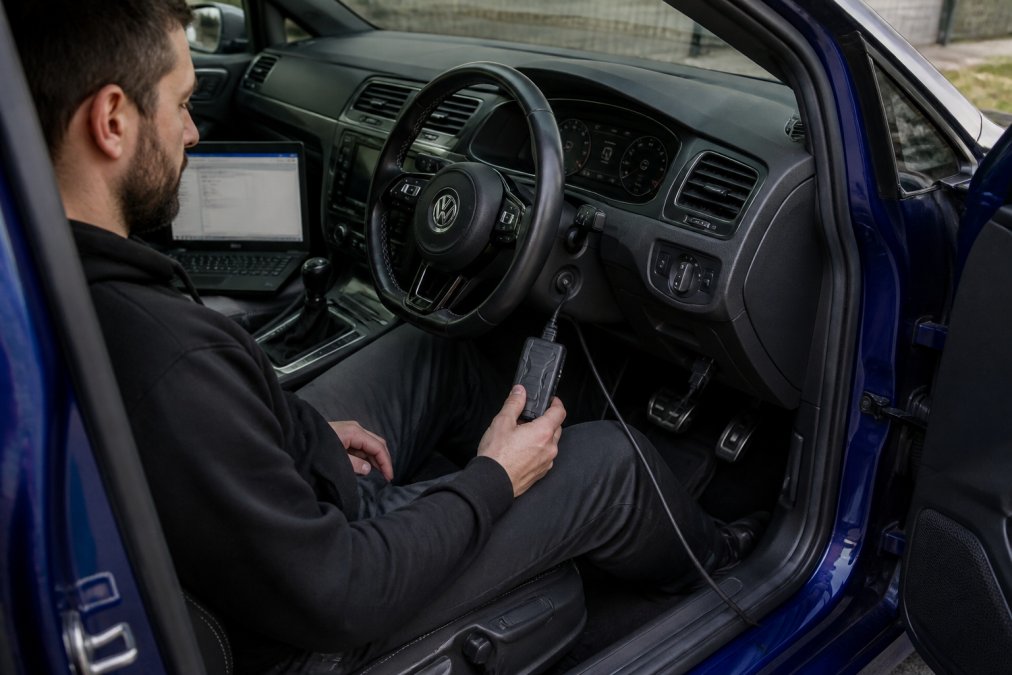
Diagnostic and Data Logging: Reading Your Car After the Flash
Data logging is how you confirm the tune is doing what it should. After the flash, pull live data from the ECU and check boost pressure against target, fuel trims, ignition timing, and knock detection counts. If boost creeps past the target or knock counts climb under load, the tune needs adjustment.
A tune is not finished when the flash completes. It is finished when the data logs show boost, fuel, and timing all sitting where the calibration expects them.
Legal, Emissions and Warranty Realities
Emissions compliance is the part most tuning content skips. Many jurisdictions require that a vehicle continue to meet its original emissions standards after any modification, and tampering with emissions control systems can make a car fail inspection or be illegal for road use. Check your local rules before you flash, and check whether your annual test includes an OBD readiness check, because a modified calibration can reset readiness monitors.
Conclusion
The gap between a tune that transforms your car and one that damages it comes down to matching the calibration to your specific hardware and monitoring the result. H&A Midwest supplies Tunezilla tunes for VW, Audi, BMW, and Mercedes with the Flashzilla Pro or v3 hardware included, so the tool and the file are matched before you plug anything in.
Frequently Asked Questions
Is ECU tuning illegal?
In most regions, ECU tuning itself is not illegal for off-road or track use, but road legality depends on local emissions standards. Removing or defeating emissions equipment is illegal in many jurisdictions, and tuned cars may fail emissions testing. Check your local rules before flashing. For daily-driven VW, Audi, BMW or Mercedes models, choose a tune that keeps emissions systems intact and passes inspection.
What is the difference between Stage 1, 2 and 3 tuning?
Stage 1 is a software-only remap on a stock car. Stage 2 requires hardware upgrades like a downpipe or intake and pushes further. Stage 3 involves a larger turbo and supporting fuel system changes. Each stage raises boost pressure, adjusts ignition timing and changes the fuel-to-air ratio, so hardware must match the calibration.
Can I do ECU tuning myself?
Yes, if your car supports OBDII port flashing. Tools like Flashzilla Pro or v3 connect to the OBD port and write the new calibration without desoldering the ECU. You need a stable battery charger, a laptop or the handheld device, and a tune file matched to your exact engine code. Most DIY tuners finish the flash in 15-30 minutes. Support from your tuning provider matters if an error code appears mid-flash.
Does ECU tuning void my factory warranty?
A tune can affect your powertrain warranty if the dealer can prove the calibration caused a failure. Magnusson-Moss style protections in some markets require the manufacturer to show causation, but this varies. Many owners flash back to stock before service visits. Keep records of your tune and any data logging. If you are leasing or under extended warranty, weigh the risk against the horsepower gains before proceeding.
How much horsepower does ECU tuning actually add?
Gains depend on engine, fuel and stage. Gains depend on engine, fuel and stage. A dyno sheet before and after is the only way to confirm real gains on your specific car.
What are the risks of improper ECU tuning?
Bad tunes cause overboost conditions, knock detection failures, and Code P0234 errors. Pushing turbo boost pressure beyond hardware limits can damage the turbo, pistons or clutch. Cheap files that ignore sensor signals risk lean conditions. Stick with a tuner who logs data, respects the torque curve limits of your transmission, and provides support if something goes wrong. A powertrain warranty on the tune itself is worth asking about.
What is the best ECU tuning tool for a beginner?
Look for a handheld flasher that connects through the OBDII port, stores your stock file, and supports your specific ECU firmware. The Flashzilla Pro and v3 are built for this, bundling hardware with the tune so you are not sourcing parts separately. Avoid tools that require desoldering the ECU unless you have bench-flashing experience. Confirm vehicle compatibility by VIN or engine code before buying.